Introduction
The “highlander store – e” sits in a grey zone of search intent—part brand query, part trust verification, and part deal-hunting behavior. Unlike clean branded searches, this query signals user uncertainty, which is exactly where high-ranking content must go deeper.
A POV-driven analytical approach, treating “Highlander Store – E” as a system within modern e-commerce, not just a storefront. The goal is to help you understand how it works, how to evaluate it, and how to buy smarter.
What Exactly Is Highlander Store – E?
On the surface the word itself suggests a labeled online store. However, most of the time this term represents a non-standard naming format at the e-commerce platform that correlates to seller-defined modification and not necessarily an official branded one.
| Element | Description | Strategic Insight |
|---|---|---|
| “Highlander” | Budget fashion brand | Known for affordable, trend-driven apparel |
| “Store” | Marketplace listing | Not always official |
| “- E” suffix | Platform/seller variation | Often algorithm-generated or manually added |
| Platform context | Amazon, Flipkart, Myntra | Influences trust level |
The “- E” suffix is not part of Highlander’s official branding system. It functions more like a label within a fragmented seller ecosystem. Which introduces both opportunity (lower prices) and risk (inconsistent quality or authenticity).
How Highlander Store – E Fits into the E-Commerce Ecosystem
To understand its behavior, you need to zoom out and look at the multi-layered marketplace architecture.
Marketplace Structure
| Layer | Role | Risk Level |
|---|---|---|
| Manufacturer | Produces Highlander apparel | Low |
| Brand Owner | Controls official listings | Low |
| Third-Party Sellers | List products independently | Medium–High |
| Marketplace Platform | Hosts listings | Medium |
| Consumer | End buyer | High exposure |
Operational Flow
| Step | Process | What Can Go Wrong |
|---|---|---|
| Product sourcing | Seller procures stock | Counterfeit or old inventory |
| Listing creation | Seller uploads product | Misleading images/descriptions |
| Pricing setup | Discount-based pricing | Artificial MRP inflation |
| Order fulfillment | Platform/seller ships | Delay or wrong item |
| Post-sale support | Returns/refunds | Seller-dependent friction |
Highlander Store – E should not be treated as a single trusted entity. But as a node within a decentralized retail network.
Product Portfolio and Positioning
Highlander operates in the high-volume price-sensitive, budget end of the fast fashion market.
Category-Level Breakdown
| Category | Product Types | Price Range (₹) | Demand Level |
|---|---|---|---|
| Denim | Slim-fit, distressed jeans | 799–1999 | High |
| T-Shirts | Graphic, solid, oversized | 399–999 | Very High |
| Shirts | Casual, checked, printed | 699–1299 | High |
| Jackets | Bomber, denim, hooded | 999–2499 | Medium |
| Bottomwear | Joggers, chinos | 699–1799 | Medium |
Product Quality Matrix
| Parameter | Rating (Budget Context) | Explanation |
|---|---|---|
| Fabric Quality | Medium | Not premium, but acceptable |
| Stitching | Medium | Varies by batch |
| Fit Consistency | Medium-Low | Size variation exists |
| Style Relevance | High | Trend-driven designs |
| Price Efficiency | High | Strong value proposition |
Pricing Strategy: Discount Psychology at Play
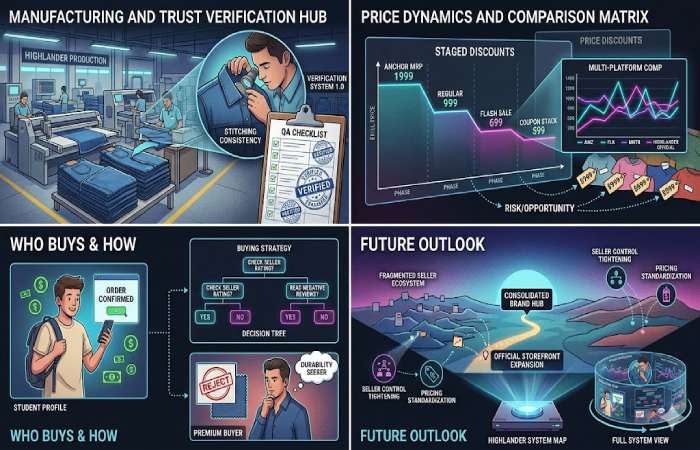
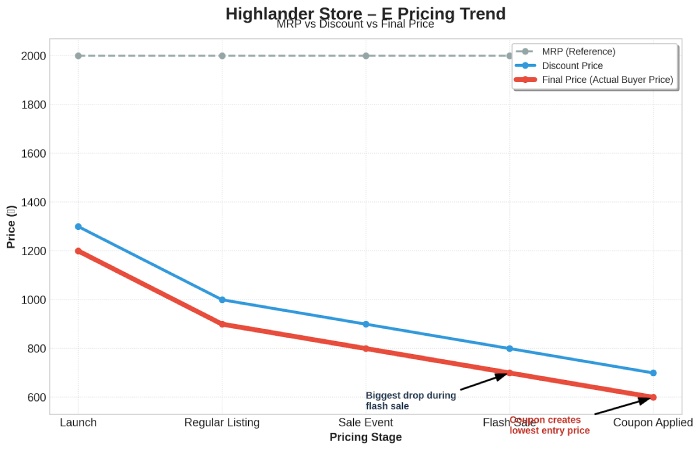
The Highlander falls under a high-MRP high discount model that prevails throughout Indian e-commerce.
Pricing Structure
| Stage | Example Price | Strategy |
|---|---|---|
| MRP | ₹1,999 | Anchoring high value |
| Regular Discount | ₹999 | Perceived deal |
| Flash Sale | ₹699 | Urgency trigger |
| Coupon Stack | ₹599 | Conversion push |
Behavioral Economics Insight
| Trigger | Impact on Buyer |
|---|---|
| “70% OFF” labels | Creates urgency |
| Limited-time deals | Encourages impulse buying |
| Cross-platform variation | Forces comparison behavior |
The real value lies not in the discount percentage, but in the final price relative to quality.
Highlander Store – E vs Competing Brands
To evaluate its real position, comparison is essential.
| Feature | Highlander Store – E | Roadster | HRX | Bewakoof |
|---|---|---|---|---|
| Price Range | Low | Medium | Medium | Medium |
| Trend Responsiveness | High | High | Medium | High |
| Brand Consistency | Low–Medium | High | High | High |
| Fabric Quality | Medium | Medium-High | High | Medium |
| Trust Level | Variable | Strong | Strong | Strong |
| Return Experience | Seller-dependent | Reliable | Reliable | Reliable |
Highlander competes aggressively on price + trend speed, but loses on:
- Brand control
- Quality consistency
- Trust clarity
The Trust Problem: Why Users Search This Keyword
The surge in searches for “highlander store – e” is primarily driven by uncertainty and risk mitigation behavior.
Common User Concerns
| Concern | Explanation |
|---|---|
| Is it legit? | Confusing store naming |
| Is it original? | Multiple sellers |
| Why is it cheap? | Heavy discounting |
| Can I return it? | Policy inconsistency |
Risk Breakdown
| Risk Type | Severity | Likelihood |
|---|---|---|
| Fake products | Medium | Moderate |
| Poor quality batch | Medium | High |
| Size mismatch | Low | High |
| Return rejection | High | Low–Medium |
How to Verify a Genuine Highlander Listing
Do not rely on assumptions but utilize a structured verification framework.
Verification Checklist
| Factor | What to Look For | Ideal Signal |
|---|---|---|
| Seller rating | Check score | 4.0+ |
| Review quality | Image-based reviews | Real usage photos |
| Fulfillment tag | Platform-backed | “Fulfilled” or “Assured” |
| Return policy | Clear terms | 7–10 day returns |
| Price consistency | Compare listings | No extreme deviation |
Red Flags
| Warning Sign | Meaning |
|---|---|
| Extremely low price | Possible counterfeit or defect |
| No reviews | New/unverified seller |
| Generic product images | Stock photos only |
| No return option | High risk |
User Experience: What Buyers Actually Get
Advantages
| Benefit | Why It Matters |
|---|---|
| Low entry price | Accessible to students |
| Trendy styles | Keeps wardrobe updated |
| Wide availability | Easy to find deals |
Limitations
| Issue | Impact |
|---|---|
| Inconsistent sizing | Trial-and-error buying |
| Fabric variation | Unpredictable durability |
| Seller fragmentation | Trust issues |
Who Should Buy (and Who Should Avoid)
Ideal Buyer Profiles
| User Type | Suitability | Reason |
|---|---|---|
| Students | High | Budget-friendly |
| First-time buyers | Medium | Needs guidance |
| Trend followers | High | Fast fashion cycles |
| Bulk buyers | Low | Quality inconsistency |
Not Ideal For
| User Type | Reason |
|---|---|
| Premium buyers | Fabric quality not sufficient |
| Long-term durability seekers | Fast-fashion limitations |
| Brand-conscious users | Lack of brand clarity |
Buying Strategy: A Smarter Approach
Instead of treating each listing equally, apply a decision framework.
Decision Matrix
| Scenario | Recommended Action |
|---|---|
| First purchase | Start with one item |
| Big discount | Cross-check price history |
| Unknown seller | Avoid or research deeply |
| Multiple listings | Compare reviews and ratings |
Optimization Strategy
| Step | Outcome |
|---|---|
| Compare 2–3 platforms | Better price discovery |
| Read negative reviews | Identify real issues |
| Check return policy | Reduce risk |
| Avoid impulse buys | Better decisions |
Future Outlook: Will Highlander Fix This Fragmentation?
There are signs pointing toward gradual brand consolidation.
| Trend | Expected Impact |
|---|---|
| Official storefront expansion | Higher trust |
| Seller control tightening | Less counterfeit risk |
| Pricing standardization | Reduced confusion |
| Quality improvements | Better retention |
As of now, Highlander still operates in a semi-decentralized model, meaning:
- Opportunities for deals remain high
- Risks remain equally present
Conclusion
“Highlander Store – E” is not a traditional online store. It’s a reflection of how modern e-commerce operates in a decentralized, seller-driven environment. So Highlander Store – E, is not one store but more of a marketplace phenomenon where there are official brands mixed with third party sellers, and algorithmically arranged lists. That is what gives it its strength and its risk. If you’re willing to look at it like a system to measure as opposed to a brand you simply want to rely on you can make a fortune. Otherwise, it’s chance.